
Open Platform
MOD is built to be changed. The OS images are open, community-built images are an recognized release channel, and there are several ways to make your own plugins, from a plain-language description to a Pure Data patch.
Modify MOD
The OS is open
Since MOD OS 1.13.5 (October 2024), the OS images for the MOD Dwarf, Duo and Duo X are published unencrypted. You can take an official image apart, change it, repack it and share the result with others. The packaging steps are documented on the wiki.
Modified images are supported by their authors and the community, not by MOD. You can always go back to an official image.
Starless, the first community image
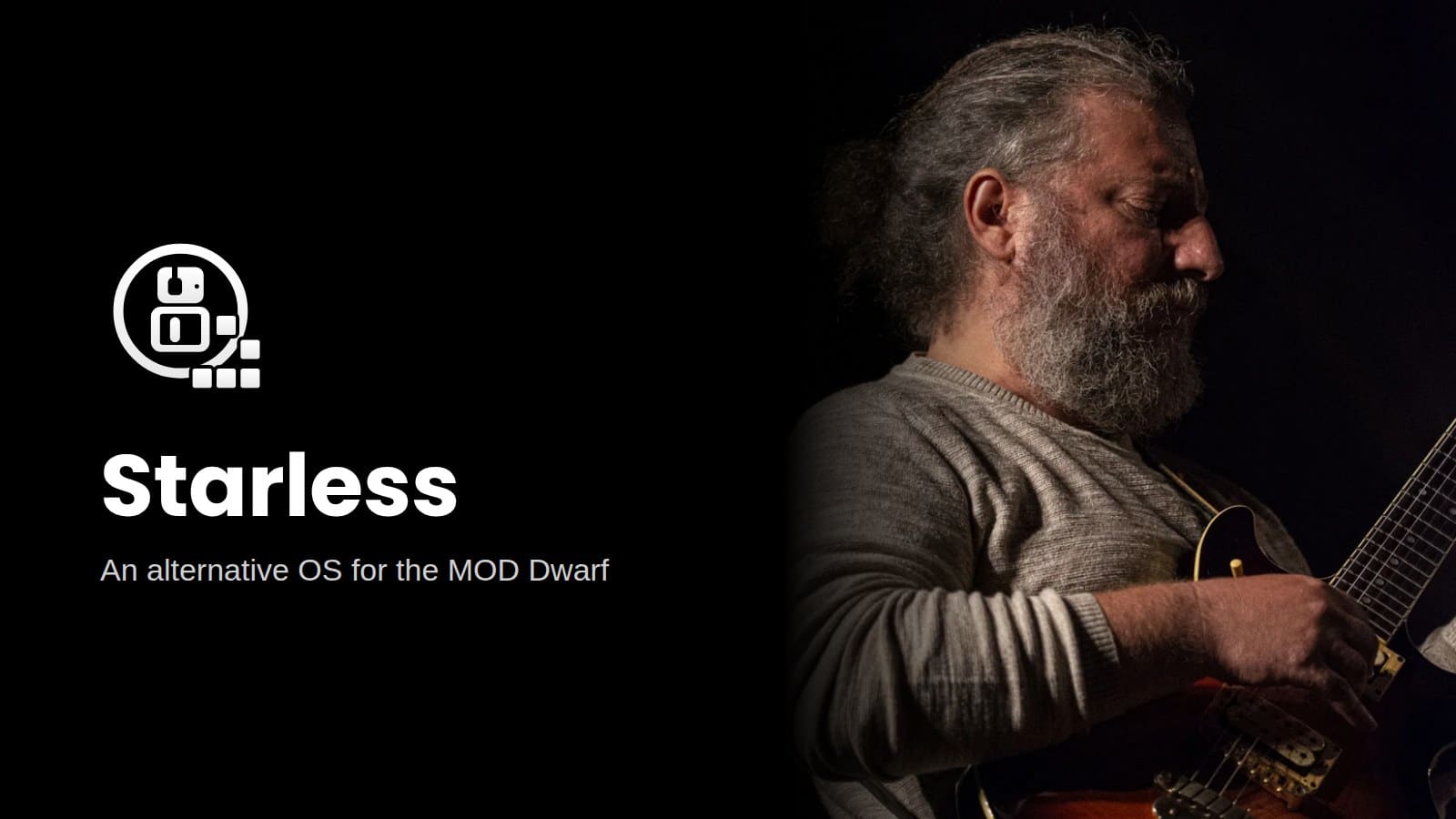
Andrea Del Signore, a guitarist and Dwarf owner, used the open images to build Starless, an alternative OS for the Dwarf focused on playing live: editing pedalboard parameters without a computer, the Performance View, port groups, and much more. It is now on version 17, developed with other community members. Starless is Andrea’s project, with its own name and schedule.
How MOD OS is developed
Starless showed that when the software is open, the people who use it every day improve it. So official MOD OS releases now go through three channels, a model inspired by long-running open source projects like Debian:
STABLE
Official production releases, after testing. What most users run.
TESTING
Official release candidates, built from MOD’s work and community contributions, offered in the web interface. A new one every two to four weeks.
COMMUNITY
Independent images, built and distributed by their authors. Starless is the first.
Testing is open to everyone: install a release candidate and use the “Report an Issue” button in the web interface. MOD OS 1.14, the first release candidate under this flow, brings Tone3000 into the web interface, so you can browse and load amp captures and IRs directly on your device.
Create for MOD
MOD plugins are LV2 plugins, built for the devices’ ARM processors. You don’t need to set up a cross-compiling toolchain to make one: the MOD Cloud Builder does the building for you, for the Dwarf, Duo and Duo X.
Describe it
With the plugin cookbook, you describe the effect you want in plain words to an AI assistant. It writes a build file, the Cloud Builder compiles it, and the plugin appears on your device. No programming needed.
Patch it
Build a plugin from a Pure Data patch (compiled with hvcc) or from Max gen~ code, right in the browser.
Code it
Write your DSP in FAUST, or package your own C/C++ plugin as a Buildroot package. The full toolchain, mod-plugin-builder, is open source if you prefer to build locally.
The MOD Plugin SDK
The MOD Plugin SDK is the reference documentation for building LV2 plugins for MOD devices, end to end: requirements, building, Buildroot recipes, validating, installing on a device, designing the plugin’s on-screen interface (modgui), metadata and categories, and licensing for commercial plugins.
Community members have already shared dozens of their own plugins on the forum, from tuners to step gates to CV utilities.
Where it happens
Everything on this page started as a conversation on the MOD forum: the plugins, Starless, the release candidates and the reports that shape them. The source code lives on GitHub, the documentation on the wiki.
Get MOD news by email
Releases, community projects and new ways to build. Sign up to get them in your inbox.